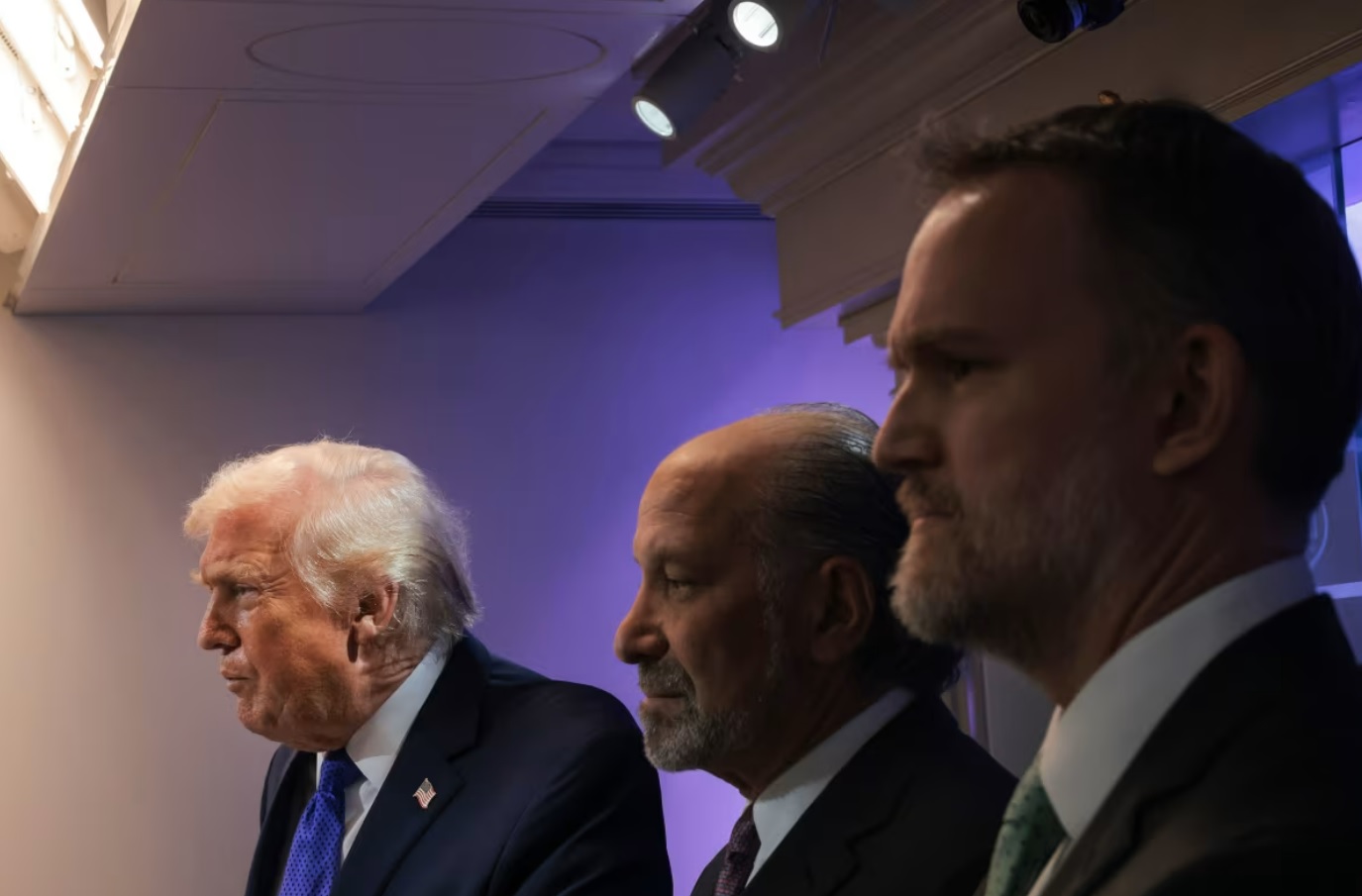
No, President Donald Trump isn’t looking for a new “most beautiful word” in the dictionary to replace his beloved tariffs.
True to his philosophy of never accepting a defeat, he’s already battling back after the Supreme Court declared his exercise of emergency trade war powers unlawful.
Ahead of his State of the Union address on Tuesday, Trump is vowing to avenge the most damaging loss of his second term by promising even higher duties on imports. Many Republicans, however, would prefer a course correction as midterm elections loom.
The president’s defiance brings great political risks for him and his party, and new uncertainties for an uneven economy. It is also already opening a new lane for Democratic attacks.
But he’s still convinced tariffs will unlock booming prosperity, even if a likelier outcome is a heavier affordability burden on millions of American voters.
“What the Supreme Court said is that the president cannot use the IEEPA, the Emergency Economic Powers Act, to do this,” Treasury Secretary Scott Bessent told CNN’s Dana Bash on Sunday. “The president does have other authorities.”
Bessent said on “State of the Union” that Trump will shore up his tariffs by using other laws as a five-month “bridge” to a more permanent regime.
But Democratic Sen. Andy Kim told on “Inside Politics” that his party was already working on legislation to force Trump to repay consumers for higher costs inflicted by tariffs — the first of a string of likely measures aimed at embarrassing the president and making life difficult for Republican lawmakers.
Trump will press on for two main reasons.
First, he believes in tariffs with evangelical intensity. His faith in them is so intense it blanks out any evidence they are a tax on consumers or that they don’t work. He regards globalization’s gutting of industrial heartlands where he won millions of votes as vindication of protectionist views he’s held since the 1980s.
“I have very effectively utilized tariffs over the past year to make America great again,” the president said Friday, ignoring new data that shows an unmoving annual trade deficit and declining manufacturing jobs.
The second reason for Trump’s refusal to bend is that tariffs are a means to his ultimate ends of unfettered presidential authority and rejection of a constitutional system that by design shares power across government.
This was highlighted by the most revealing comment from Trump’s fulminating press conference Friday following the court’s decision, when he was asked why he didn’t just work with Congress to pass new tariffs.
“I don’t have to. I have the right to do tariffs,” he said.
Trump has used tariffs more expansively than any modern president, in a way that stretches far beyond economic policy. If a foreign nation angers him, it’s punished — as with Brazil, which got a 50% tariff slap for investigating his friend former President Jair Bolsonaro over alleged election-meddling. If a world leader shows insufficient deference, their nation pays the price. Trump has explained, for example, that he hiked tariffs on Switzerland after taking exception to how its leader “talked to us” — apparently referring to former President Karin Keller-Sutter.
But showing such muscle will be harder going forward.
Alternative powers Trump now plans to use to maintain tariffs contain compliance requirements and more limited authorities that may mean he can’t use levies as a personal thermostat to crank up heat according to his whim.
Trump has a blunt, transactional worldview. He sees curbs on his tariff leverage as weakening the US against rivals he perceives as endlessly exploiting the world’s most powerful economy. The Supreme Court ruling may undermine his trade war ahead of expected summits with Chinese leader Xi Jinping this year.
“Foreign countries that have been ripping us off for years are ecstatic, they’re so happy, and they’re dancing in the streets, but they won’t be dancing for long — that, I can assure you,” the president said Friday.