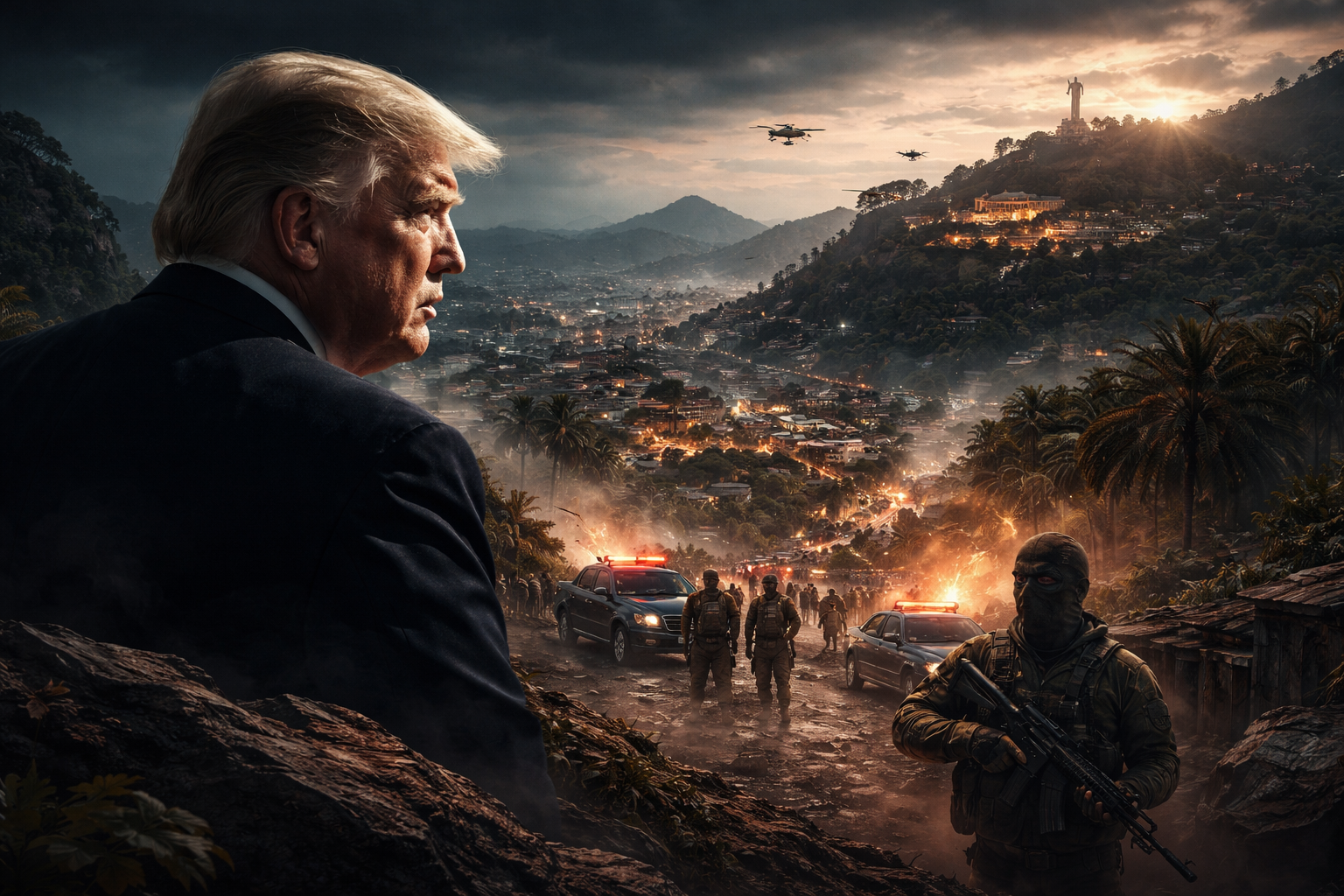
His meddling in Latin America reveals a coherent project: power without borders, accountability or allegiance to any nation.
This week, Honduras inaugurated a new president under extraordinary circumstances. Nasry Asfura, a construction magnate, was backed by members of the notorious MS-13 and publicly supported by Donald Trump. Days before the vote, gang members threatened to kill anyone who didn’t support Asfura, while Mr. Trump warned Hondurans there would be “hell to pay” if they chose a different outcome. His victory marked the rehabilitation of a political party long associated with cartels — and a glimpse into Mr. Trump’s broader project.
Mr. Trump has repeatedly intervened in Latin America: meddling in elections, capturing Venezuela’s president, Nicolás Maduro, in a military operation to face U.S. drug charges, threatening Colombia’s president with arrest and floating military strikes against Mexican cartels. These actions may seem chaotic. They are not. They follow a single logic: expanding power for transnational elites who operate beyond national law.
That logic was made explicit with Mr. Trump’s pardon of Juan Orlando Hernández, Honduras’s former president and one of the region’s most notorious drug traffickers. Sentenced in 2024 to 45 years in prison for leading a massive cocaine conspiracy, Mr. Hernández was freed under the claim that he was the victim of a political “witch hunt.” The pardon aligned neatly with calls from the Claremont Institute and Mr. Trump’s ally Roger Stone, who argued that restoring Honduras’s right-wing party would protect Próspera, a semiautonomous “start-up city” on the island of Roatán.
Próspera is backed by Trump-aligned tech investors and operates as a special economic zone, with minimal taxes and weakened labor and environmental rules. Such zones, once rare, now number in the thousands worldwide. Their promoters claim they generate prosperity; critics argue they funnel public resources into private hands while eroding sovereignty.
When Honduras’s progressive president, Xiomara Castro, moved to shut Próspera down, its backers sued the country for nearly $11 billion — a sum that could bankrupt one of the hemisphere’s poorest nations. Similar corporate-driven enclaves have displaced communities from Puerto Rico to Central America.
MAGA leaders often warn that immigration will turn the United States into the “third world.” What they ignore is that Mr. Trump is importing the very governing model the United States helped impose abroad: one where corporate power merges with the state, violence enforces inequality and citizens become disposable.
This is not blowback or karma. It is design. By stripping millions of immigrants of legal status, Mr. Trump has expanded the pool of vulnerable labor that transnational elites exploit, while American workers are forced to compete with criminalized wages.
Mr. Trump’s project is not about nationalism. It is about dismantling sovereignty so profits can move freely across borders. MAGA was never a revolt against elites. It was their most effective instrument.