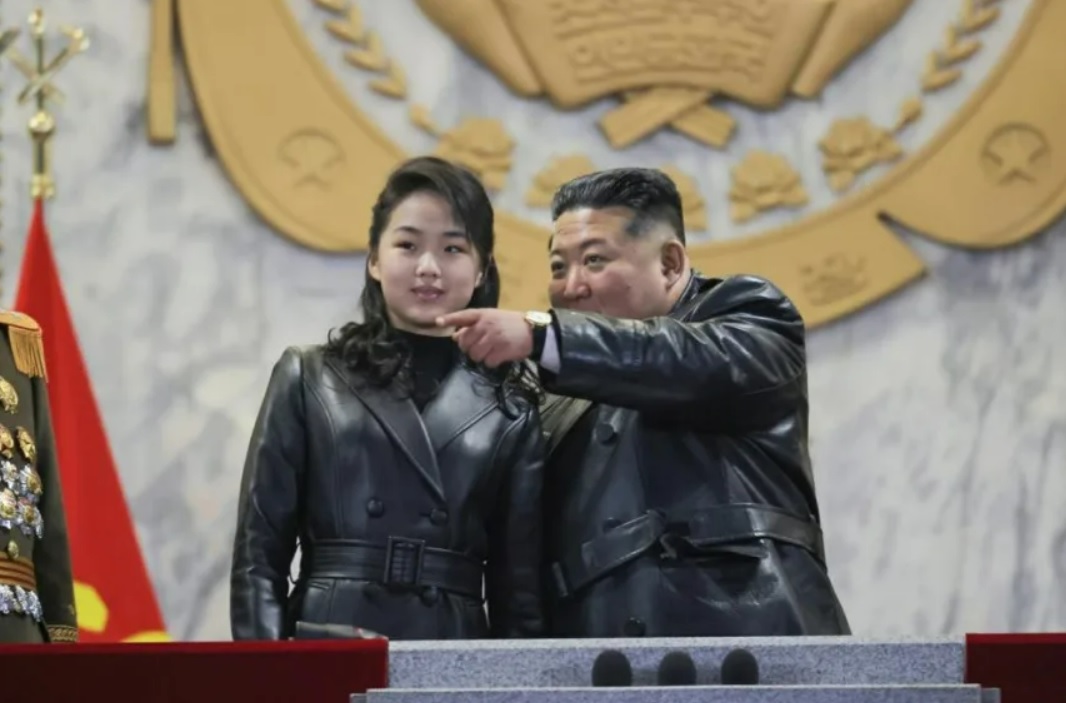
North Korean leader Kim Jong Un promised to strengthen his country’s nuclear weapons program on Wednesday, before presiding over a nighttime military parade, accompanied by his daughter.
About 14,000 troops marched through Kim Il Sung Square in the capital of Pyongyang, state media said. Columns of soldiers were seen goose-stepping under floodlights with fighter jets roaring overhead.
Kim’s teenage daughter, widely believed to be named Ju Ae, again appeared prominently at the parade beside her father. But despite speculation in South Korea about her potential grooming as a successor, no new official titles were announced as the once-in-five-years ruling party congress wrapped.
In his closing remarks at the congress, Kim doubled down on expanding the nation’s nuclear arsenal. He called it the party’s “firm will” to strengthen national nuclear power and increase both the number of weapons and the means to deploy them.
But at his parade, most military hardware was conspicuously absent. No procession of tanks, no towering intercontinental ballistic missiles (ICBM), no hypersonic glide vehicles, no transporter-erector-launchers rumbling past the cameras.
The restraint is noteworthy because the Kim regime often uses parades to showcase its most menacing weapons, and state propaganda has been leaning into weapons imagery recently.
Just last week, state media aired footage of Kim appearing to take the wheel of a 600mm multiple rocket launcher – a system North Korea has touted as “nuclear-capable” – with rows of dozens of launch vehicles lined up in striking formation. And only four months ago, North Korea staged a massive rain-soaked military parade marking the ruling party’s 80th anniversary, showcasing what state media called its most powerful ICBM and other new strategic systems.
North Korea’s Ninth Workers’ Party Congress, a largely rubber-stamp political gathering of the nation’s elite, also brought personnel changes at the top.
Kim’s powerful sister, Kim Yo Jong, was promoted to director of a party department after years in a deputy role, solidifying her standing in the inner circle. Several senior party and military posts were reshuffled, elevating younger loyalists while unanimously “reelecting” Kim as general secretary for another five-year term.